



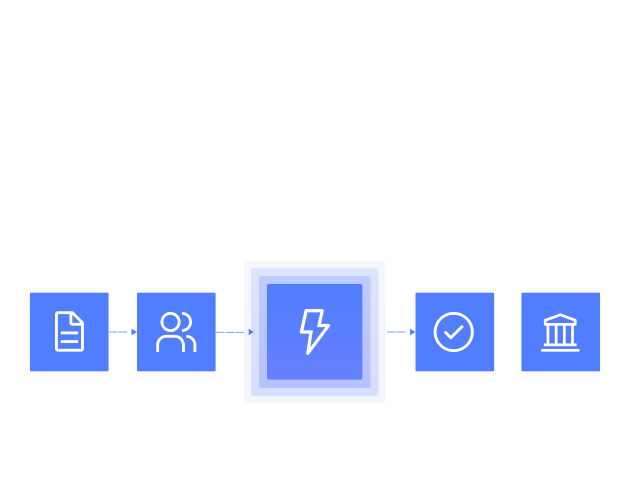
Front Office Automation for Faster, Smarter Securities Finance
Modern securities finance demands speed, precision, and advanced decision-making. Equilend Front Office Automation automates the securities finance trade lifecycle, bringing inventory management, pricing, lending and borrowing automation, and execution together in one intelligent workflow. Trading desks can respond faster to market opportunities, reduce manual intervention, and scale operations with greater speed and accuracy.

Manual workflows slow down modern trading desks
Front-office challenges
Today’s securities finance markets move faster than ever. Modern trading desks need to execute, price, source inventory, and respond to market events in real-time. When those activities depend on disconnected systems and manual processes, opportunities can be missed and operational complexity increases.
A unified trading workflow
As trading volumes grow and settlement cycles shorten, every manual touchpoint adds unnecessary complexity. Equilend Front Office Automation unifies inventory management, borrow processing, pricing, and execution into a single automated workflow, helping firms respond faster, improve utilization, reduce operational risk, and scale their securities finance businesses without increasing operational overhead. It also strengthens the connection between front-office decisions and downstream lifecycle management, eliminating inefficiencies before they occur.
Why firms choose Equilend Front Office Automation
Respond faster to market opportunities

Adapt to market changes in real-time

Reduce operational risk and compliance burden

Scale without adding operational complexity

One unified front-office ecosystem
See Front Office Automation in action
Watch how automated front-office workflows change the trading day.
Automating every stage of the front-office workflow

Automate trade execution
Eliminate manual touchpoints across the securities finance trade lifecycle by automating inventory sourcing, borrow processing, pricing, and execution. Front Office Automation enables trading desks to execute faster, improve accuracy, and spend more time focusing on market opportunities instead of operational tasks.

Respond faster to market opportunities
Automate inventory distribution with Autolend, Push Lists, and SmartBorrow workflows that intelligently connect inventory with market demand. Trading desks can respond quickly to changing market conditions, improve inventory utilization, and reduce delays caused by manual intervention.

Adapt pricing in real-time
Leverage the Pricing Engine and Rate Optimizer to automate pricing decisions using configurable business rules. Respond dynamically to changing market conditions with consistent pricing strategies that improve execution quality while maintaining control across lending programs.

Scale operations without operational complexity
As trading volumes grow, Front Office Automation enables firms to process more activity without increasing operational overhead. Cloud-based, configurable workflows automate repetitive processes, allowing trading teams to scale efficiently while maintaining speed, accuracy, and operational control.
One unified securities finance ecosystem
Front Office Automation is designed to connect every stage of the securities finance trade lifecycle within the broader Equilend ecosystem. By bringing together inventory management, lending workflows, borrow processing, pricing logic, execution, and downstream processing, firms can eliminate manual handoffs, improve straight-through processing, and create a more connected, scalable trading environment.
With seamless integration across complementary Equilend solutions, trading desks gain greater visibility, faster execution, and a unified workflow that supports smarter decision-making across both lending and borrowing activity, from trade initiation through post-trade processing and lifecycle management.
SPEAK TO OUR EXPERTSOne powerful platform

Key features and product capabilities
Feature
Description
Autolend
Autolend automates inbound borrow requests for lending desks by centralizing demand, applying configurable rules, checking availability and pricing, and either executing eligible trades or routing exceptions for trader review. By combining automation with trader-defined controls, firms can respond faster to lending opportunities, reduce manual effort, improve workflow efficiency, and maintain oversight across their lending activity.
SmartBorrow
SmartBorrow automates borrower-side workflows by identifying short positions, generating and routing borrow requests, negotiating rates, and executing confirmed trades based on trader-defined rules. By combining configurable decision logic, counterparty routing, market data, and straight-through processing, firms can reduce manual effort, improve response times, optimize borrowing costs, and maintain oversight across their borrowing activity.
Rate Optimizer
Rate Optimizer automates trade re-rating by identifying underperforming trades, recommending optimized rates using market data and configurable rules, and executing re-rate workflows based on trader-defined controls. By combining real-time rate intelligence, historical analytics, and automated proposal, counter, and acceptance logic, firms can reduce manual effort, respond faster to market changes, improve profitability, and maintain oversight across their lending book.
Pricing Engine
Pricing Engine powers automated pricing decisions by integrating market data, firm-specific benchmarks, and configurable rules to generate indicative rates in real-time. By supporting trader-defined pricing logic across lending and borrowing workflows, firms can respond faster to market conditions, improve pricing consistency, support trade automation, and maintain transparency into the data and assumptions behind each rate.
Push Lists
Push Lists automates targeted availability distribution by enabling trading desks to create, schedule, and deliver tailored inventory lists to counterparties based on configurable filters, counterparty preferences, and preferred delivery methods. By combining live availability, dynamic filtering, flexible scheduling, and full trader control, firms can improve inventory visibility, reduce manual effort, respond faster to borrower demand, and place lendable inventory where it is most likely to generate opportunity.
Trade lifecycle
Trade brings trade entry, blotter management, trade maintenance, and analytics into a single front-office workflow. Desks can capture trades, manage open loans and borrows, take in-blotter actions such as re-rates, recalls, returns, and partial fills, and analyze live or historical activity through configurable views and dynamic reporting. By centralizing execution, lifecycle management, and decision support, firms can reduce manual effort, improve visibility, and manage trading activity with greater speed, accuracy, and control.
Ready to automate your front office?
Thanks — request received.
Our team will be in touch within one business day.
Related insights

Blog May 19, 2026
From Fragmentation to Integration: Rethinking the Securities Finance Lifecycle
Securities finance has long run on a structural divide between front-office trading and post-trade operations. As T+1 becomes the baseline and T+0 comes into view, that divide is breaking down. Tony Camarota on how Spire 3.0 unifies decisioning and lifecycle control on one real-t

White Paper March 17, 2026
The T+1 Transition Priorities
Europe’s move to T+1 will fundamentally reshape post-trade operations. This white paper explains what breaks first, where risk concentrates, and how firms can prepare.

Blog March 9, 2026
The Quiet Countdown to T+1 Settlement in Asia
The global move to T+1 settlement is no longer theoretical.
Frequently asked questions
What is Front Office Automation?
Front Office Automation streamlines inventory management, lending workflows, borrow processing, pricing, and trade execution. It helps firms automate repetitive front-office processes across both lending and borrowing activity, improve operational efficiency, and respond more quickly to market opportunities.
Who is Front Office Automation designed for?
Front Office Automation supports broker-dealers, agent lenders, principal lenders, retail brokers, and other securities finance market participants looking to automate front-office workflows.
How does Front Office Automation improve operational efficiency?
By automating manual workflows across inventory management, pricing, borrow requests, and execution, firms can reduce operational complexity, minimize manual intervention, and improve consistency across trading activities.
Does Front Office Automation integrate with other Equilend solutions?
Yes. Front Office Automation is designed to work alongside the broader Equilend ecosystem, helping connect front-office workflows with complementary trading, data, and post-trade solutions.
Can workflows be configured to support our business requirements?
Yes. Front Office Automation supports configurable workflows and business rules, allowing firms to tailor automation to their operational processes and trading strategies.
Connecting
Securities Finance
Stay ahead in securities finance with expert insights, market trends, and timely updates.